For many of us, one of our favorite ways to spend time during the holiday season is curling up with one of our favorite holiday books. Over the years, the Chets Creek December Book of the Month has often been a holiday themed selection. This year, because good readers sometimes choose to reread books we know we love, we spent time together remembering and enjoying many holiday books, some old and some new, some silly and some sad.
One of the oldest and most beautiful stories, The Little Match Girl, was written by Hans Christian Anderson and first published in 1845. It takes place on the wintry evening streets from long, long ago. As with many fairy tales and traditional tales, the story of this poor, lonely girl has been told and retold many times throughout the years. In some versions, it is New Year's Eve. In others, it is Christmas Eve. In some, it is just any winter night.
As with some of Hans Christian Andersen's other popular stories The Little Mermaid and Thumbelina, for instance, this beautiful story has been made into short films many times in history. Perhaps the most beautiful version of this story is told entirely without words. Take a few moments to watch Disney's version of this timeless classic and read Hans Christian Andersen's story. Make sure to have your tissues handy!
Do you think consider this a happy or sad ending?
What do you think the theme of this story is?
Does this story remind you of any other books you've read?
Sunday, December 18, 2011

Thursday, November 24, 2011
St. Augustine
Our recent field study to St. Augustine was fantastic! Not only did we validate so much of the knowledge that we already have learned in Social Studies and Readers Workshop, but we also learned a few new interesting facts.
Did you know that it took 23 years to build the Castillo de San Marcos and that the Spanish kept their livestock in the moat around the fort when they were being attacked by their enemies? We also learned that in addition to the bell tower in one corner of the fort, that there are also 3 other corner towers with the purpose of acting as lightning rods! We also got to meet the oldest living member of St. Augustine, Old Senator, a huge tree that is over 600 years old and STILL GROWING!! His trunk is 33 feet around in circumference! We loved our fort tour and the trolley tour around the city. It was a beautiful day where all that we have learned in school really became personal for us as we got to experience it all up close. What was your favorite part of our trip? Leave a comment to earn some Behavior Bucks. Oh, and enjoy the slideshow!
St. Augustine on PhotoPeach
Did you know that it took 23 years to build the Castillo de San Marcos and that the Spanish kept their livestock in the moat around the fort when they were being attacked by their enemies? We also learned that in addition to the bell tower in one corner of the fort, that there are also 3 other corner towers with the purpose of acting as lightning rods! We also got to meet the oldest living member of St. Augustine, Old Senator, a huge tree that is over 600 years old and STILL GROWING!! His trunk is 33 feet around in circumference! We loved our fort tour and the trolley tour around the city. It was a beautiful day where all that we have learned in school really became personal for us as we got to experience it all up close. What was your favorite part of our trip? Leave a comment to earn some Behavior Bucks. Oh, and enjoy the slideshow!
St. Augustine on PhotoPeach
Tuesday, November 22, 2011
Stuck on Reading
Principal Phillips sure wowed us recently when she got STUCK on the wall in the front foyer! She convinced us that it is rewarding and exciting to get stuck on great books! She was reading a whole pile of them when we visited her! I am sure every one of our Young Supers is working hard to meet the 2nd 9 Week Book Goal so that they can participate in our upcoming midyear reading celebration! What book are you currently "stuck" on, Young Supers? Leave a comment and tell us all about it!
Saturday, October 29, 2011
Magnet Explorations
Our first day exploring with magnets proved to be quite interesting. In addition to having some fun, we also brought out a lot of our prior knowledge about magnets and their properties, which the students learned back in 2nd Grade.
*All magnets have invisible magnetic fields.
*Some magnets are stronger than others.
*Magnets come in different shapes and sizes.
*The Earth is like a giant magnet.
*Magnetism is a force (push/pull).
*All magnets have a North and a South Pole.
*Like poles repel (or push away from each other).
*Opposite poles attract (or pull toward each other).
Upcoming investigations will explore what happens to a magnet's poles when the magnet is broken. We will also make a temporary magnet and test its varying strength when it is magnetized to different levels of strength. After participating in a Gizmo virtual lab on magnetism, students will design and create their own magnet experiments by formulating and exploring their own "testable questions".
Enjoy our slideshow. :-)
Explorations with Magnets on PhotoPeach
*All magnets have invisible magnetic fields.
*Some magnets are stronger than others.
*Magnets come in different shapes and sizes.
*The Earth is like a giant magnet.
*Magnetism is a force (push/pull).
*All magnets have a North and a South Pole.
*Like poles repel (or push away from each other).
*Opposite poles attract (or pull toward each other).
Upcoming investigations will explore what happens to a magnet's poles when the magnet is broken. We will also make a temporary magnet and test its varying strength when it is magnetized to different levels of strength. After participating in a Gizmo virtual lab on magnetism, students will design and create their own magnet experiments by formulating and exploring their own "testable questions".
Enjoy our slideshow. :-)
Explorations with Magnets on PhotoPeach
Monday, October 17, 2011
Variables
Variables on PhotoPeach
In studying agents of weathering & erosion in recent weeks, our classes have learned to identify variables in scientific investigations. By the way, we think hands-on science is REALLY COOL!
Controlled Variables- also known as “Controls”
These are set-ups that remain in their original condition as we participate in an investigation, so that after a lab, we can look back at them and compare our end results with what the original, “un-touched” condition was like.
Untouched “sugar cube”, “cookie”, and “sand tray”


Independent Variables- also referred to as what “I” did (“I”ndependent)
This refers to what "we" as the experimenters change as we progress through a lab.
We changed from slow to vigorous shaking to see the effects of “wind” weathering on “rocks” (sugar cubes).
We changed from 5 squirts, to 10 squirts, to 15 squirts to see “water” weathering on earth (cookies).
We changed from "no wind breaker" (barrier) to adding a wind breaker in order to see how people work to prevent “wind” erosion.
“D”ependent Variables- also referred to as the (“D”ata)
This refers to what "we" as the experimenters change as we progress through a lab.
We changed from slow to vigorous shaking to see the effects of “wind” weathering on “rocks” (sugar cubes).
We changed from 5 squirts, to 10 squirts, to 15 squirts to see “water” weathering on earth (cookies).
We changed from "no wind breaker" (barrier) to adding a wind breaker in order to see how people work to prevent “wind” erosion.
“D”ependent Variables- also referred to as the (“D”ata)
This refers to what changed or happened in the experiment as a result of the Independent Variable (what "I" did).
*The vigorously shaken cubes were more weathered than the gently shaked cubes.
*The more saturated cookies were more weathered than the less saturated cookies.
*The wind breakers stopped the wind from eroding and hitting the “building” at the end of the tray.
For Behavior Bucks, leave a comment on what the independent and dependent variable would be in the following experiment:
Carter's Plant Experiment.....
Carter wants to test the effects of plant growth with and without sunlight. He buys two identical plants at the hardware store. He puts "Plant A" in a dark closet and "Plant B" in front of a window to receive sunlight. Each day he checks his plants and records data on what he observes. He also carefully waters each plant the same amount of water once each week. After three weeks, Carter finds that Plant B grows better because it receives sunlight.
What was the independent variable in this experiment?
What was the dependent variable in this experiment?
Be sure to leave your first name at the end of your comment!
*The vigorously shaken cubes were more weathered than the gently shaked cubes.
*The more saturated cookies were more weathered than the less saturated cookies.
*The wind breakers stopped the wind from eroding and hitting the “building” at the end of the tray.
For Behavior Bucks, leave a comment on what the independent and dependent variable would be in the following experiment:
Carter's Plant Experiment.....
Carter wants to test the effects of plant growth with and without sunlight. He buys two identical plants at the hardware store. He puts "Plant A" in a dark closet and "Plant B" in front of a window to receive sunlight. Each day he checks his plants and records data on what he observes. He also carefully waters each plant the same amount of water once each week. After three weeks, Carter finds that Plant B grows better because it receives sunlight.
What was the independent variable in this experiment?
What was the dependent variable in this experiment?
Be sure to leave your first name at the end of your comment!
Divide and Conquer
In Math Workshop, we have been working to connect division to multiplication. Many times, we even find ourselves thinking of division problems as multiplication problems so that we can use a multiplication strategy to solve them.
Consider 56 divided by 4
When looking at this division problem, we ask ourselves, “How many 4’s are in 56?”. By doing this, we recognize that we will be finding the number of groups of 4 that are in 56, or _____ x 4 = 56.
Consider 56 divided by 4
When looking at this division problem, we ask ourselves, “How many 4’s are in 56?”. By doing this, we recognize that we will be finding the number of groups of 4 that are in 56, or _____ x 4 = 56.
Many students then find it simple to use an efficient form of Skip-Counting by multiples of 4 to determine the answer. Starting with the 10th multiple of 4 would be very common. The answer is 14. It takes 14 groups of 4 to equal 56.

Other students would incorporate this same strategy into a different model, such as a Multiplication Cluster. The approach uses decomposition of one of the factors to make smaller, easier probloems. In the example below, again 14 is decomposed into 10 and 4 to make the two easier problems. 10 groups of 4 is 40. Adding another 4 groups of 4 (4x4) or 16 “builds” 14 x 4 = 56.  56 divided by 4 can also be thought of as 56 divided by 2, and again divided by 2 (dividing by 2 twice is the same as dividing by 4). Some students like to refer to this strategy as the “Halfsie-Halfsie”. 56 divided by 2 is 28. 28 divided by 2 is 14. This strategy only works when 4 is the divisor.
A more advanced strategy would be to take the dividend (total) and decompose it into smaller multiples of the divisor to make smaller division problems that would “build “ (add up to) the original division problem. This method is called a Division Cluster. 56 could be decomposed into 20 + 20 + 16 and solved as three smaller division problems. 20 divided by 4 is 5. 20 divided by 4 is 5. 16 divided by 4 is 4. 56 divided by 4 is 14.

Last but not least, the Partial Quotients Method (also lovingly referred to as the “Russian Peasant” Method), is a special model we move our students toward in order to progress their thinking into a more “standard algorithmic” set-up. If you look carefully at the smaller problems that are solved in each of the examples shown below, you will see that they are the same as in the earlier examples. Even though the mathematical “models” are different, the “strategy” of using good mathematical sense to decompose the dividend into smaller numbers (landmark multiples of ten or single digit numbers) is the same, so that the reasonableness of solutions can be easily assessed (Does my answer make sense?).
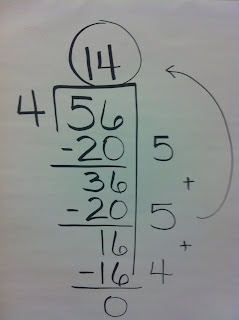
 Our approach is a conceptual-based approach, teaching students that there is a relationship between multiplication and division and there is a meaning as to the dividend, divisor, and quotient. One represents the total (dividend) and the other two parts represent the number of groups and the size of the groups that make up the total.
Promoting this deep understanding at Grade 4 will then more easily transfer later (5th Grade) into understanding why the division algorithm works (which is very abstract in nature and cumbersome to understand conceptually).
Happy Dividing!
P.S.- Students, leave a comment sharing your favorite divison strategy (and why), and earn Behavior Bucks to spend at your next class auction!
Saturday, October 15, 2011
What Can I Do to Help?
 You might be wondering, as we approach the end of the first nine weeks, what you can do to help your reader do better. While Mrs. Montero and Mrs. Nash are really excited and proud to see improvements in many young readers already, we know 4th grade reading can be HARD.
Here are some things you can do to help your child on their reading comprehension tests.
1. Each time a grade comprehension test comes home, help them to revise every item they missed, even if they earned an A! Some of our most powerful learning in life comes from our mistakes, and reading comprehension tests are no different. When revising, read through the entire passage with your child first. Then, discuss ALL of the answer choices and how we know they are right or wrong. Constantly refer back to the clues in the text, knowing that some clues are clearly stated and others are scattered throughout the text.
2. Ensure that your child is reading for 20 minutes or more each night. No, we are not telling you to get out the timer and start counting pages and minutes again. We are reminding you that reading is the single most powerful practice available. Research and experience tells us that readers who really and truly are reading every single day (Yes, that means weekends, too.) are more successful in all areas of learning. Think of daily reading as a daily multivitamin for their school success. It is critical.
3. Schedule time throughout the week and weekend for your child to use FCAT Explorer. This tool has been available to Florida students for years. It is aligned to the same standards assessed on these classroom reading comprehension tests, as well as the FCAT.
4. Make sure your child is in class daily. The instructional strategies we use at Chets Creek cannot be duplicated with a worksheet at home. When children miss school, they are missing out on learning. We try to "catch them up" as best we can, but it is never quite the same.
5. Start a "Mommy and Me" or "Daddy and Me" book club and read WITH your child. Often we think that because our readers are old enough to read independently and in their heads, we don't need to read with them anymore. However, reading shared with an adult is not just independent practice anymore, but an opportunity to learn new ways of thinking about their reading. In addition to being a powerful family experience, sharing a book with your child allows you to talk with them about the book, giving them a window into the mind of an adult reader. Having the support of a "leader reader" also allows your child to climb inside a story or text that might have been too difficult for them on their own. When you hear a tiny thought in your head saying, "Oh, he's going to ....." or "Why did she do that?", speak these thoughts aloud to your child and open a discussion. Talk about what the author wrote that sparked those thoughts in your mind.
With busy schedules, it might not be realistic to say you will sit down and read with them every single night. But perhaps you choose a book to share and read it every other night, two days a week, or on the weekends. The other days, your young reader can read their own independent book.
Subscribe to:
Posts (Atom)